
What Is the Dictionary of Feelings and Needs?
The Dictionary of Feelings and Needs is a practical guide to emotional vocabulary, self-awareness, empathy, and conscious communication.
With 108 feelings and 108 needs, each accompanied by accessible definitions, it was created to help people move beyond vague or habitual emotional language and develop a deeper understanding of what they are genuinely experiencing and needing.
Many of us grow up with surprisingly limited language for inner experience. We may know we are "fine," "stressed," "upset," or "angry," yet struggle to identify the more nuanced feelings and needs beneath those broad labels.
The Dictionary was designed to support that exploration.
It offers accessible descriptions of feelings and needs language while encouraging greater emotional literacy, reflection, and clarity.
The work grew out of years of mediation, facilitation, teaching, and the development of The Empathy Set® cards and app.
Why Emotional Vocabulary Matters
The ability to name our inner experience shapes the way we relate to ourselves and others.
When emotional experience remains vague or undifferentiated, people often struggle to communicate clearly, regulate emotions effectively, or understand what is truly important in a situation.
We may react automatically without understanding why.
We may confuse judgments with feelings, or blame with unmet needs.
We may know something feels wrong, yet lack the language to describe it.
Developing emotional vocabulary helps create clarity.
Research in emotional intelligence and neuroscience increasingly suggests that the ability to identify and differentiate emotions supports:
emotional regulation
self-awareness
empathy
communication
conflict resolution
and relational connection
Sometimes the simple act of finding the right word changes the experience itself.

Beyond "Fine," "Bad," and "Stressed"
Many people discover that they have far more emotional nuance than they realized.
What initially appears as anger may contain:
disappointment
hurt
fear
grief
overwhelm
discouragement
longing
or loneliness
Similarly, what first appears as a practical disagreement may reveal deeper needs for:
respect
understanding
inclusion
trust
autonomy
safety
contribution
or belonging
The Dictionary helps bring these layers into awareness, not to overanalyze emotion, but to relate to experience with greater honesty, precision, and compassion.
The Relationship Between Feelings and Needs
At the heart of this work, drawing on Marshall Rosenberg's Nonviolent Communication, is a simple idea:
feelings often point toward needs.
When important needs are met, people tend to experience emotions such as connection, ease, gratitude, joy, trust, or peace.
When important needs are not met, people may experience frustration, sadness, fear, grief, disconnection, tension, or anger.
Understanding this relationship helps shift attention away from blame and toward curiosity and understanding.
Instead of asking "Who is wrong?", people begin asking "What matters here?", "What is needed?", and "What is this feeling pointing toward?"
That shift often changes conversations profoundly.
For Oneself and Others

A quiet but important choice runs through every entry in the Dictionary. Each of the 108 needs is defined as the need for oneself and others to... Not the need for others. Not the need for oneself. But both, held together in the same breath.
Consider the definition of empathy itself:
Empathy refers to the need for oneself and others to understand and share another's feelings and needs from their perspective, communicating this understanding with sensitivity, and responding compassionately.
The same pattern runs through all 108 entries. Acceptance, understanding, attention, care, kindness, respect, each framed this way.
This is not stylistic. The empathy we offer others and the empathy we need to offer ourselves are not two different things. They are the same capacity, turned in two directions. When we empathize well with another person, we exercise the same muscle we use when we turn toward our own experience with care. When we abandon ourselves, we weaken the same muscle that reaches outward.
This is why self-empathy is not a luxury. It is the ground from which outward empathy grows.
'I' Statements and Constructive Dialogue
The Dictionary also offers guidance on translating insight into conversation. At the center of this is the 'I' statement, a simple structure for communicating with honesty and care.
An 'I' statement has four components:
an observation of what actually happened
the feeling that arose in response
the need or value that the feeling points toward
a clear request for what would help
For example: "I feel anxious when our meetings run overtime, because of my need for punctuality to my next meeting. Could we please end on time in the future?"
The Dictionary provides further examples and structured guidance to help readers move from emotional reaction toward grounded, constructive communication.
How People Use the Dictionary
People use the Dictionary of Feelings and Needs in many different ways, including:
journaling and self-reflection
emotional literacy practice
preparing for difficult conversations
therapy and coaching
mediation and facilitation
parenting and education
leadership development
relationship work
empathy and listening exercises
Some people read it straight through. Others return to it repeatedly during moments of conflict, uncertainty, emotional overwhelm, or personal reflection.
A Companion to The Empathy Set®
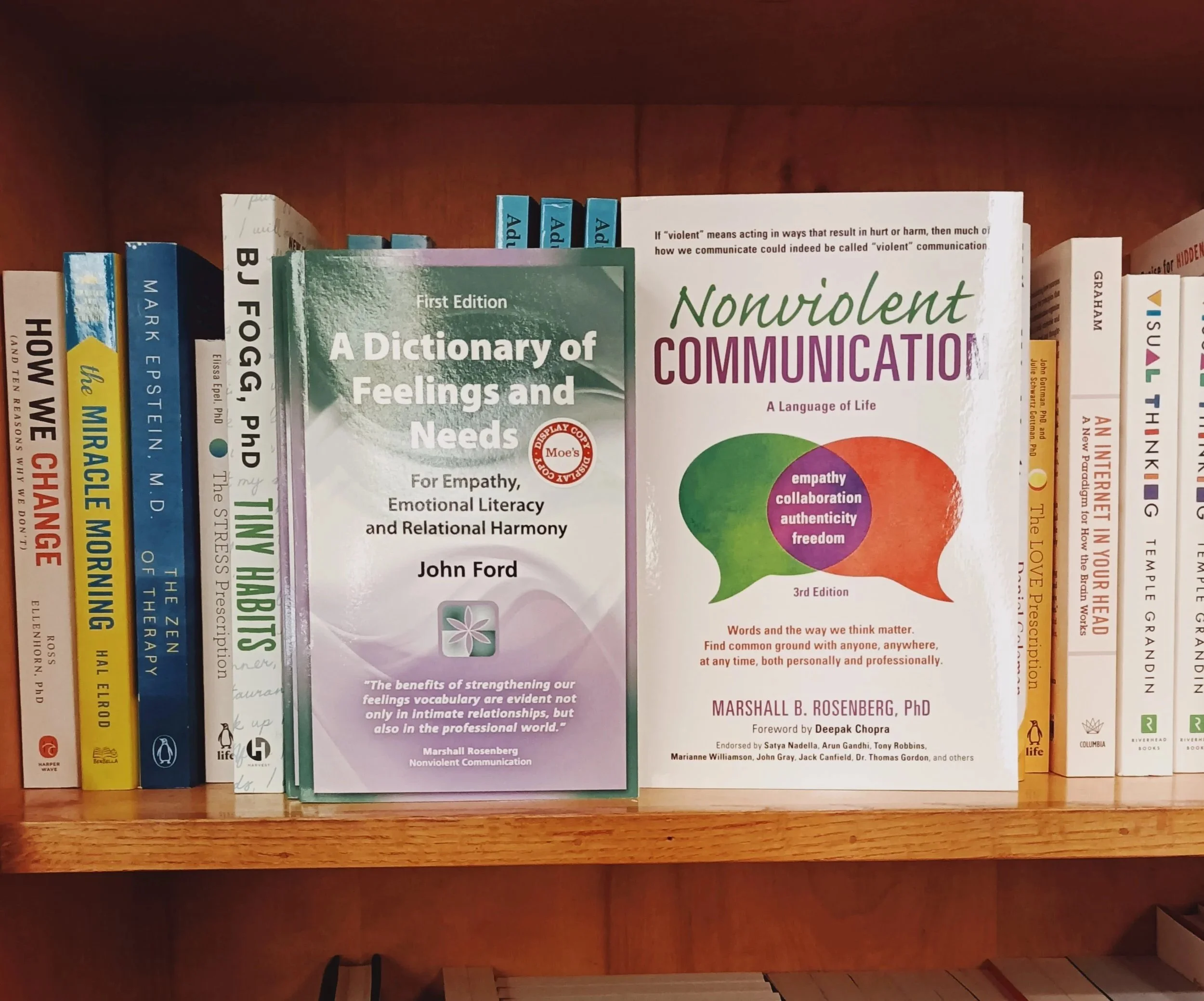
The Dictionary of Feelings and Needs on the shelves at Moe’s Books, Berkeley
The Dictionary is the natural companion to the Original Edition of The Empathy Set®.
The Original Edition presents the feelings and needs as words alone, without definitions on the cards. This invites intuitive, in-the-moment discovery. The Dictionary is what readers reach for when a word resonates but its meaning feels uncertain, or when a deeper exploration would help.
The Definitions Edition and The Empathy Set® App already include the definitions, so the Dictionary functions there as a deeper reference for those who want fuller context.
Together, the Original Edition and the Dictionary support both intuitive resonance and considered understanding, each in its own time.
Learn More
You can explore The Empathy Set® cards, The Empathy Set® App, the Empathy Guide, and writings on empathy, emotional literacy, and communication through the resources on this site.
Explore the Dictionary
Explore the available formats and related resources in the store.