The Talking Stick: A Simple Tool for Better Conversations
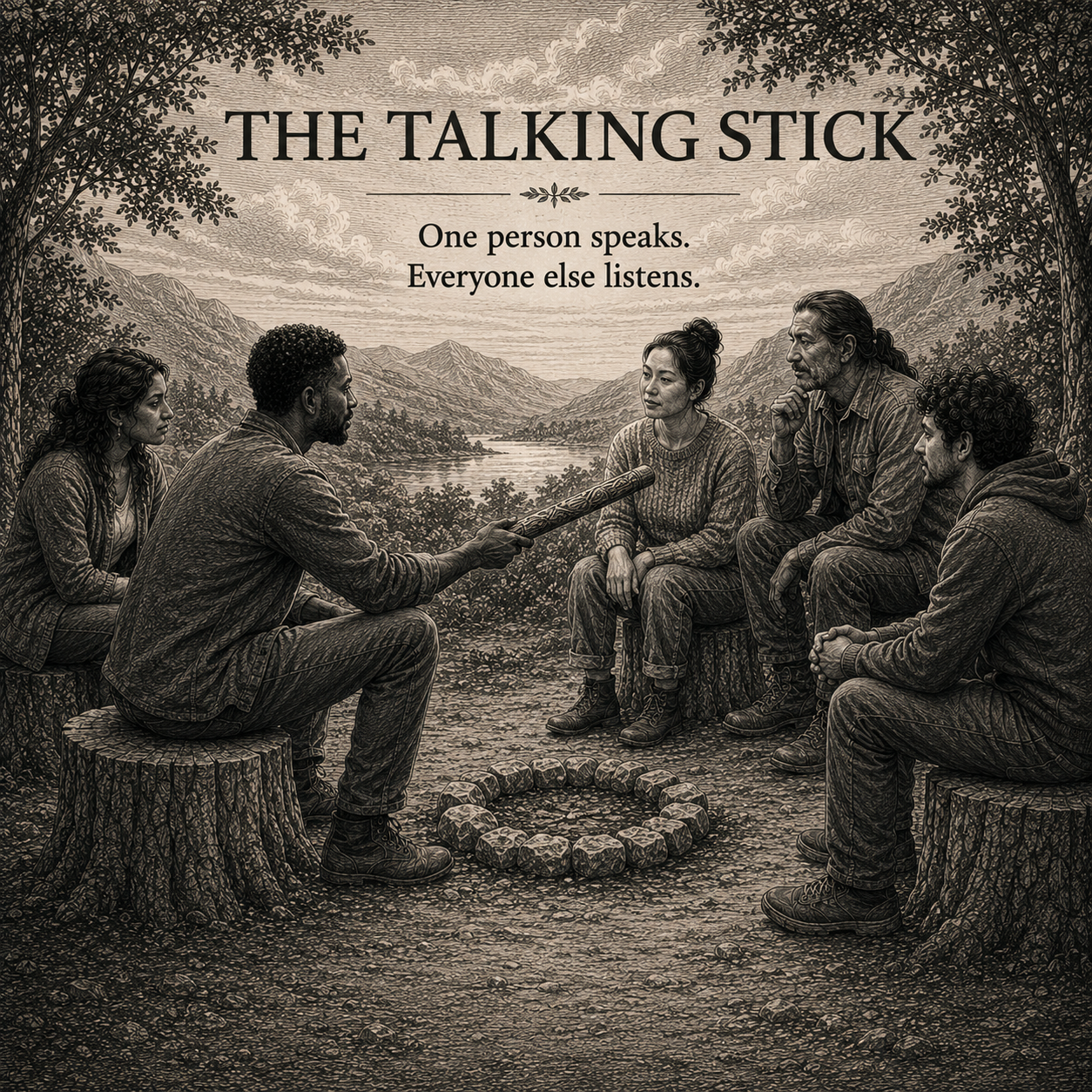
The Talking Stick
We tend to blame failed conversations on people. Difficult personalities. Poor listeners. Strong emotions. Sometimes that is fair. But often the real problem is simpler, and easier to fix.
Many conversations fail because there is no structure.
Everyone wants to be heard. Everyone has something they believe matters. So people interrupt, defend, rehearse their reply while the other person is still talking, or quietly give up and withdraw. The result is frustration, misunderstanding, and conflict that had little to do with anyone's character.
The talking stick offers a surprisingly simple way through.
Why conversations go wrong
When a conversation becomes emotionally charged, attention narrows. Instead of listening to understand, we start listening for threats, for mistakes, for openings to defend ourselves.
Listening tends to collapse in a few predictable ways. We rehearse our response instead of following where the speaker is going. We prejudge, deciding we have heard this before and filing the person under a familiar category. We jump to fixing, offering solutions before the problem has even been named. We drift, present in body but gone in attention. And we make the premature claim, "I understand," three words that offer no evidence and often land as a way to close the conversation rather than open it.
People do not relax when you announce that you understand them. They relax when they hear their own meaning reflected back.
Even skilled communicators fall into these patterns when emotions run high. The challenge is rarely a lack of goodwill. It is a lack of structure.
The hidden value of structure
Consider a busy intersection. Without traffic lights, even careful drivers would struggle. The light does not make anyone a better driver. It creates conditions that let everyone move safely.
The talking stick works the same way. It creates a simple structure that makes two roles unmistakable: who is speaking, and who is listening. For a brief period, everyone knows exactly what is being asked of them.
This is much of what a mediator provides. A mediator manages the process so participants can focus on the conversation itself, ensuring uninterrupted speaking time, slowing things down, balancing participation, and helping regulate emotional intensity. The talking stick performs many of these functions in a portable, visible form. It is a small piece of process structure you can carry into any room.
How the talking stick works
The rules are simple. The person holding the stick speaks without interruption and holds the floor for as long as they need it. The others may not make their own points, argue, or disagree while someone else holds the stick. When the speaker is finished, they pass it on, and anyone may pass if they would rather not speak.
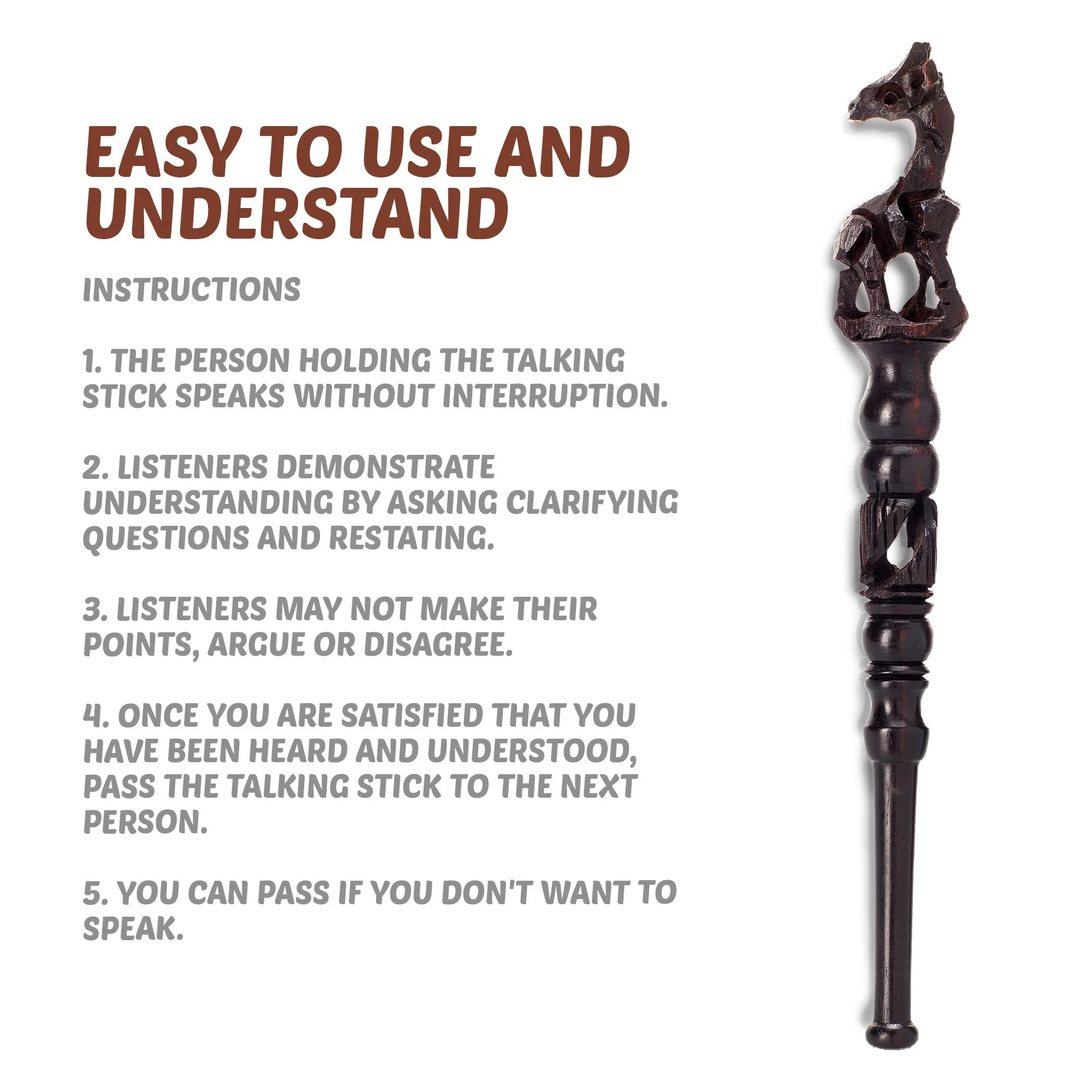
What the listeners do with their turn to listen depends on how you are using the stick, because there are two common ways.
The object itself does not matter. A stick, a stone, a pen, anything will do. What matters is the agreement that travels with it. The group commits to honoring the speaking and listening roles the object marks.
Stephen Covey called the talking stick "the most powerful communication tool I have ever seen." Its power lies precisely in its simplicity. It can be used in families, between couples, in teams, in classrooms, in community circles, and of course in mediation.
Two ways to use it
The first is a sharing circle, or round robin. Each person takes a turn to speak to a topic while the others give their full attention, and the stick simply moves around the group until everyone has been heard. A team debrief after a project, a classroom check-in, an opening round at a meeting. Here the listeners are mostly receptive. The work of the stick is to guarantee turns and to keep attention on whoever is speaking. No one is reflecting back; they are simply present.
The second is the one I lean on most, and the one most suitable for interpersonal conversations, especially when you both have something to say and both want to be heard. Here the listeners are active. They demonstrate understanding by asking clarifying questions and restating what they have heard, and the speaker keeps the stick until they feel genuinely heard and understood before passing it on.
One refinement makes this second use work better. The speaker can ask for uninterrupted time first. Some people need to get the whole thing out before anyone reflects anything back, and a premature clarifying question, however well meant, can land as an interruption. So the speaker sets the pace: say it all, then invite the clarifying and restating only when ready. The floor, and the timing of being met on it, belongs to the person holding the stick.
What the stick cannot do on its own
Here is what most descriptions of the talking stick leave out.
The stick governs who speaks. It does nothing about how they speak.
A person can hold the floor, protected and uninterrupted, and use that time to lecture, blame, belittle, or demean. When that happens, the very structure meant to create safety ends up shielding the person causing the harm. The quiet participants the stick was supposed to protect simply sit and absorb it.
This is why the talking stick is only half of an agreement. Good conversation rests on two commitments, and the stick makes only the first one visible.
The first commitment is that one person speaks at a time. Notice that this is not the same as "no interrupting," which is only a prohibition. The positive version carries more weight: when you speak, I listen fully. The stick makes this commitment visible and easy to keep.
The second commitment is that we keep it civil and respectful. We will not demean, belittle, blame, or attack. Disagreement is welcome. Contempt is not. This is the container that makes honesty safe, and no object can enforce it for you. It has to be carried by the people in the room.
So the stick handles the structure of who. The people handle the spirit of how. When both halves are honored, the loop closes. The speaker uses the floor to be understood rather than to dominate, and the listener offers real attention rather than waiting for a turn. Take either half away and the tool stops working.
Listening is not waiting
It is worth being honest about that listener's half, because silence is easy to fake.
Staying quiet while you mentally prepare your rebuttal is not listening. It is waiting with your mouth closed. The speaker can usually feel the difference, even if they cannot name it. Something in them senses whether they are being received or merely tolerated.
The invitation is to become genuinely curious about the other person's experience. Not to agree, not to approve, simply to understand what it is like to be them right now. And curiosity has a voice. This is where the listener's clarifying questions and restating come in, not to take the floor, but to show the speaker that what they said has actually been received. The stick keeps you from taking over. It does not ask you to disappear.
The power of passing
One of the least understood features of the talking stick is the right to pass.
No one is ever required to speak. This matters, because genuine dialogue cannot be forced. Sometimes a person needs more time. Sometimes they are not yet sure what they think. Sometimes they feel overwhelmed. Sometimes they would simply rather listen.
The freedom to pass protects autonomy and dignity. And it has a surprising effect. People often speak more honestly when they know they are free not to speak at all. The right to pass turns participation from an obligation into a choice, and choice is where honesty lives.
Creating balance
In most groups, a few people naturally dominate while others stay quiet. Without structure, confidence and speed decide who gets heard.
The talking stick rebalances this. It slows the fast talkers. It opens space for quieter voices. It reduces interruptions and invites reflection. For a brief moment, every participant has the same access to attention. That equality is rare, and people notice it.
Common pitfalls
Like any tool, the stick can be misused.
Long monologues are the most frequent problem. Holding the floor is not the same as filling it. Brief, focused contributions leave room for real dialogue.
Cross-talk is another. The moment participants start responding before they hold the stick, the structure dissolves. The process only works when everyone honors it, including while they wait.
And there is the discomfort of silence. Pauses feel awkward, so groups rush to fill them. Yet meaning often emerges in exactly those pauses. Moving too quickly can skip past the most valuable moment in the conversation.
With and without a facilitator
When a facilitator is present, they become the guardian of the process. They explain how it works, hold the structure, manage time, encourage balanced participation, and step in when an agreement begins to slip.
Many families, teams, and groups use a talking stick well with no facilitator at all. It helps to agree on a few things beforehand: one person speaks at a time, the right to pass, respectful language, and a shared commitment to understanding rather than winning. Light time limits can help too, so everyone gets a turn.
More than an object
The talking stick is not magic. It does not erase conflict or guarantee understanding.
What it offers is something genuinely rare: a reliable structure for speaking and listening, paired with a shared agreement about how we treat one another while the conversation unfolds.
At its best, the stick reminds us that communication is not only about expressing ourselves. It is also about making room for others. In a culture that rewards speed, certainty, and interruption, it invites a quieter practice. Slow down. Listen to understand. Speak to be understood, not to win. And remember that connection begins the moment a person feels heard.
The talking stick is one of the simplest ways we know to make that happen. It gives a conversation the structure a mediator provides. Add the right language and you are close to doing for yourselves what a mediator does for others. That is what The Empathy Set®, my deck of feeling and needs cards, was made for. The stick decides who speaks. The cards help you find the words. Together they are the perfect companions for the conversations that matter most.