Have you ever wondered about the difference between empathy and sympathy? And if you have, why sympathy has such a bad name?
Dr Brené Brown's well known video is a great place to start. In it she says that empathy fuels connection while sympathy drives disconnection, and that to empathize we have to internalize the feelings of another.
The examples she offers are ones where we avoid acknowledging another person's difficult feelings, or where we minimize their experience, such as "silver lining" it with a phrase like "at least you have a job" after hearing someone was demoted.
I agree completely that avoiding and minimizing are not empathetic. Where I want to add a little nuance is on the word sympathy itself. The disconnecting responses Brown points to are, to my mind, better named as avoidance or minimizing than as sympathy. And I think that difference matters, because it gets us closer to why sympathy has earned its bad name in the first place.
What is sympathy?
As is so often the case, the word carries more than one meaning.
Sympathy's Latin roots (sympathia and pathos) point to "similar feelings." But the primary sense in most modern dictionaries is "pity or sorrow for someone's misfortune."
Sympathy as pity is disempowering, and it does fuel disconnection. It places us above the person and their suffering rather than alongside it. Comments like "I don't want your sympathy" tell the story. We want to be allowed to feel our feelings, not to be rescued by a sympathizer who can never really feel them for us. I suspect this is the deeper reason for sympathy's bad name.
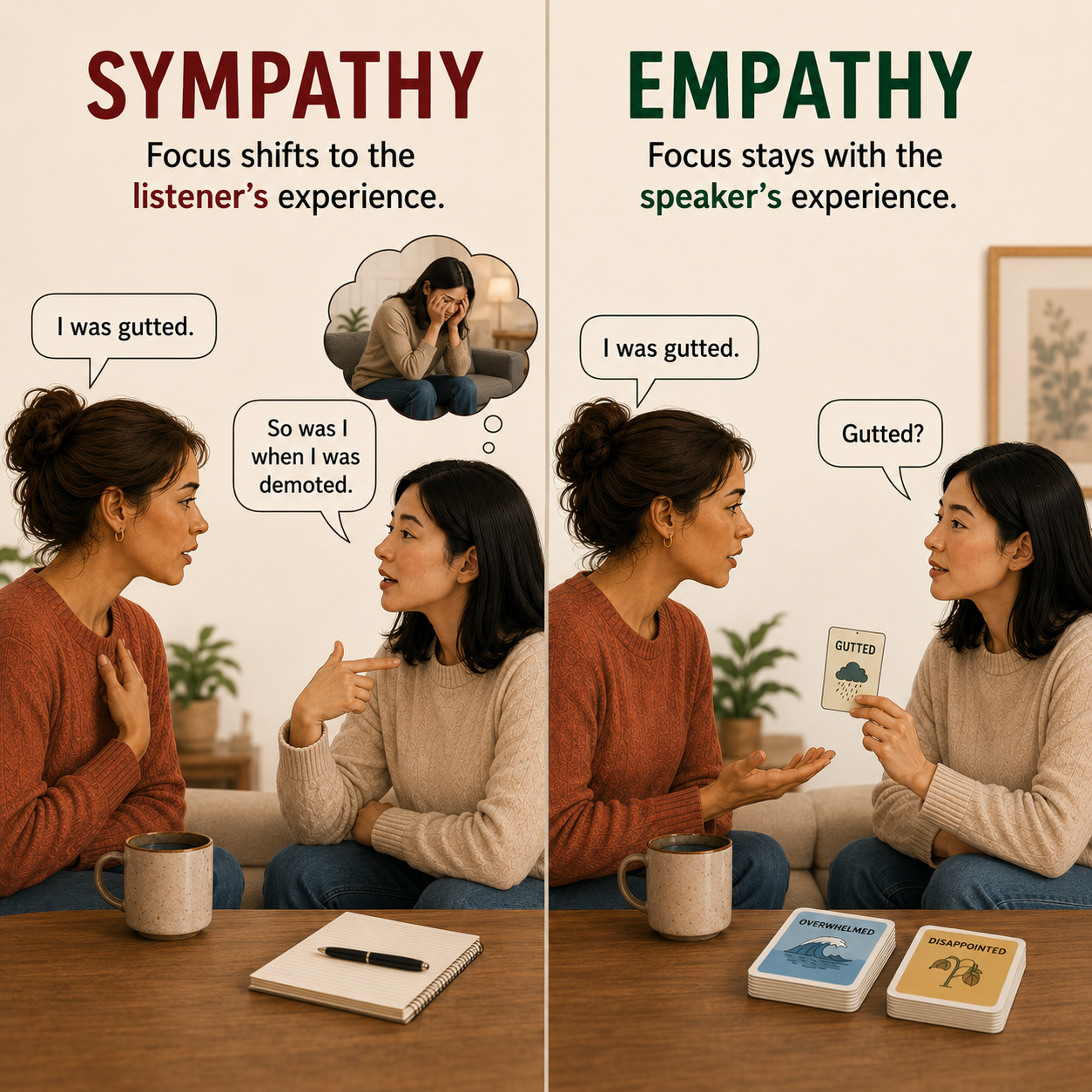
But sympathy can also carry its older meaning: our capacity to recognize a feeling we share. We sense that another person may be feeling something close to what we have felt before, and we sympathize. A friend tells us they have been demoted. Because it happened to us once too, we feel the sting, and we say, "I was gutted when that happened to me."
The apparent danger is that, unless we are careful, this shifts the focus away from the other person. Suddenly the conversation is about me and my demotion, not theirs. That is another reason sympathy can get a bad name.
What is empathy?
So what is empathy, and how is it different?
Empathy is our capacity to sense and understand what another person is feeling from their point of view, not ours, and to offer that understanding back in a form they can recognize as accurate. I have come to describe it as a blend of two capacities drawn from the wilderness tracking tradition that runs through my work: genuine perception and deep imagination. Genuine perception is reading what is actually there in the person before us, the pause before a word, the catch in the breath, rather than what our own history expects to find. Deep imagination is the creative act of entering their inner world from within, asking not what I would feel in their place but what they are feeling in theirs, and holding that picture tentatively, as an invitation rather than a verdict. I develop this fully in The Practice of Empathy.
So when my friend tells me about the demotion, I can sympathize, because I have felt that sting myself. But I can also empathize, and when I do, the shift is unmistakable: "I imagine that hit hard. You had put so much of yourself into that role."
Notice that I keep the focus on him. I do not steer the conversation toward my own demotion. Empathy lies in showing my friend that I understand him and his situation from inside his frame rather than mine, offered tentatively, as something to be confirmed rather than assumed. It builds connection, and it rests on authentic attention to the other.
When sympathy serves empathy
Here is where the shared feeling earns its place. Held with care, it is not a hazard at all but one of the most useful things we bring to a conversation. Deep imagination needs raw material to work with, and our own experience is exactly that material. If I have been demoted myself, that memory is what my imagination can draw on to picture what this person might be living through.
So having the feeling is not the problem. What matters is what I do with it. I can use it to turn the conversation toward myself, or I can use it quietly, as a way into imagining what they might be feeling, and then hold that picture loosely, as a question rather than a conclusion.
Because their experience may not match mine at all. I might assume the person who was demoted is gutted, because I was. But if I stay with them, I may find something quite different. Perhaps they are relieved. Perhaps they never wanted to supervise in the first place, and the demotion feels less like a loss than a quiet blessing. Had I let my own memory speak for them, I would have missed them entirely.
That is the difference care makes. I may mention that I was demoted too, or I may not. Either way, the real work happens underneath: the shared experience feeds my imagination while my words and attention stay with the person in front of me. Sympathy, held this way, does not compete with empathy. It can open the door. Empathy is what walks through it.
Empathy vs sympathy: the real difference
Sympathy can move us toward another person, but it is not the same as empathy. Sympathy draws on my experience. Empathy stays with theirs.
In the same way, avoidance and minimizing are neither sympathetic nor empathetic. They are simply ways of not being present.
Much ado about nothing? I'm not so sure. Words matter. Sympathy has its place, and held with care it can even open the way to empathy. But it carries real dangers. Which is why, for life's challenges, I prefer empathy.
Want to grow your own empathy?
Empathy is a skill, and like any skill it deepens with practice. If you'd like to build yours, download the free Empathy Guide, or explore The Empathy Set®, a card deck, an app, and a set of tools designed to help you bring empathy into your real conversations.
(Updated: June 4, 2026)