A note before you read (2026)
This was the first post I published on The Empathy Set blog and, looking back, I'm struck by how many of the themes that continue to shape my work were already present. My understanding of empathy has evolved since then, particularly around the distinction between imagining ourselves in another person's situation and imagining what life might be like from their perspective. Today I would place greater emphasis on what I call genuine perception and deep imagination—carefully observing, listening, and then imagining the other's experience rather than projecting our own. Still, the heart of the article remains unchanged: empathy involves understanding another person's feelings and perspectives and allowing that understanding to guide our actions.
My First Blog
I remember when I was first learning the skills of mediation encountering the idea of empathy.
First, I wasn’t sure I could define it myself. Second, I wasn’t really sure I knew why it was so important. And finally, I definitely wasn’t confident in my ability to be empathic, let alone support others in conflict, be empathic.
So, it’s been a journey, and one I am happy to take, and now am very motivated to share my discoveries and insights garnered along the way, both as a professional mediator and trainer, but also, as a human being, experiencing life.
I am eager to make empathy more accessible, more practical, and more widely used.
The starting point, is of course my first doubt and clearly defining what we mean by empathy.
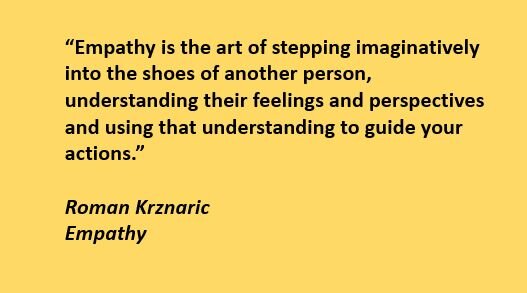
I’m sharing my current favorite definition by Roman Krznaric from his awesome book called Empathy:
“Empathy is the art of stepping imaginatively into the shoes of another person, understanding their feelings and perspectives, and using that understanding to guide your actions.”
I love that he honors the most common understanding of empathy being walking in the shoes of another. Not you in their shoes, but you imagining yourself to be them, and in their shoes.
To do this we have to imagine and draw on our life experience, but not in a way that makes it about ourselves. Our focus always is on the person for whom we are seeking to be empathic with.
When we seek to imagine what they (not us) would be feeling and what their perspective is (without judgment) we are getting into the empathy zone.
But importantly, and this is consistent with most emerging definitions of empathy, it’s not good enough to just imagine, we need to show we care by taking action.
Because, if we don’t, our expressions of empathy seem insincere and hollow.
My awareness of the importance of empathy continues to grow.
-
October 2026
- Oct 5, 2026 When Anger Speaks to Power Oct 5, 2026
-
July 2026
- Jul 3, 2026 There Is No View from Nowhere: Reflections on Empathy and Neutrality in the Mediator's Stance Jul 3, 2026
-
June 2026
- Jun 22, 2026 Why "You're Being Defensive" Backfires Jun 22, 2026
- Jun 22, 2026 How to Stop Getting Accused of Being Defensive Jun 22, 2026
- Jun 15, 2026 What Your Phone Does to a Conversation Jun 15, 2026
- Jun 15, 2026 Is Avoiding Eye Contact Always a Trauma Response? Jun 15, 2026
-
May 2026
- May 25, 2026 Storied Feelings: When a Feeling Carries a Story May 25, 2026
- May 25, 2026 Marshall Rosenberg, Nonviolent Communication, and the Power of Empathy May 25, 2026
-
January 2026
- Jan 8, 2026 AI Empathy in Mediation; When Algorithms Show Compassion Jan 8, 2026
-
October 2025
- Oct 27, 2025 Beyond the Horn: What Road Rage Reveals About the Terrain of the Body Oct 27, 2025
-
July 2025
- Jul 23, 2025 Empathy and the Art of Tracking: Following the Trail of Another’s Experience Jul 23, 2025
- Jul 9, 2025 The Challenge of Power, Corruption, and Compassion: A Path to Ethical Action Jul 9, 2025
-
April 2025
- Apr 10, 2025 Harnessing Conflict for Positive Change Apr 10, 2025
-
March 2025
- Mar 4, 2025 Elon Musk’s “Suicidal Empathy”: A Flawed Critique or a Necessary Warning? Mar 4, 2025
-
February 2025
- Feb 20, 2025 Navigating the Ocean of Emotions: Understanding Alexithymia and Emotional Literacy Feb 20, 2025
- Feb 11, 2025 When Empathy is Rejected: Staying Open Without Losing Yourself Feb 11, 2025
- Feb 10, 2025 The Strength of Compassionate Boundaries Feb 10, 2025
- Feb 4, 2025 Empathy Circles: A Path to Understanding in Times of Political Division Feb 4, 2025
-
January 2025
- Jan 22, 2025 On Compassion Jan 22, 2025
- Jan 22, 2025 Triggers Jan 22, 2025
- Jan 9, 2025 Harnessing Emotional Energy to Transform Conflict In Mediation Jan 9, 2025
- Jan 5, 2025 From Reaction to Response: Choosing Conscious Conflict Resolution Jan 5, 2025
-
November 2024
- Nov 19, 2024 Resonant vs. Discordant Leadership: Navigating the Balance Between Connection and Accountability Nov 19, 2024
- Nov 12, 2024 Rage Rooms: Exploring Their Impact on Anger and Emotional Well-Being Nov 12, 2024
- October 2024
-
September 2024
- Sep 24, 2024 Empathy Steps Sep 24, 2024
- Sep 16, 2024 934: Harnessing CONFLICT, PEACE, and a culture of resolutions for team success w/ John Ford Sep 16, 2024
- Sep 12, 2024 Podcast Interview of John Ford by Shawn Edwards: The Empathy Set to build EI and develop Conflict Resolution Skills Sep 12, 2024
- Sep 12, 2024 The Neuroscience of Empathy: A Key Skill for Mediators Sep 12, 2024
-
August 2024
- Aug 14, 2024 Emotional Avoidance: The Hidden Crisis in Our Lives Aug 14, 2024
- Aug 12, 2024 Needs And Requests Aug 12, 2024
- Aug 6, 2024 Neuroscience Meets Social and Emotional Learning podcast! Aug 6, 2024
-
July 2024
- Jul 26, 2024 The Emotion Thesaurus and the Power of Emotional Vocabulary Jul 26, 2024
- Jul 10, 2024 Reflections on Inside Out 2 Jul 10, 2024
-
June 2024
- Jun 26, 2024 Embrace Empathetic Listening with Perspective-Getting Jun 26, 2024
- Jun 20, 2024 A Dictionary of Feelings and Needs: Feedback Project Word of the Day: Afraid Jun 20, 2024
- Jun 20, 2024 Why We Created the Dictionary of Feelings and Needs Jun 20, 2024
- Jun 19, 2024 Embracing Emotionality: Eight Foundational Beliefs About Our Emotions Jun 19, 2024
- Jun 19, 2024 What Inside Out 2 Reveals About the Diversity of Emotions Jun 19, 2024
- Jun 14, 2024 Five Practices for a Healthier Emotional Life Jun 14, 2024
- Jun 6, 2024 What are your Unfelts costing you? Jun 6, 2024
-
April 2024
- Apr 30, 2024 The State of the Heart Report Apr 30, 2024
-
March 2024
- Mar 14, 2024 Awakening Each Other Through Love Mar 14, 2024
-
February 2024
- Feb 8, 2024 Good Company: Moe's Books Feb 8, 2024
-
January 2024
- Jan 5, 2024 Nonviolent Communication and Boundaries Jan 5, 2024
-
December 2023
- Dec 18, 2023 Halve Your Stress in Seconds: The Power of Naming Emotions! Dec 18, 2023
-
October 2023
- Oct 27, 2023 The Power of Trust Oct 27, 2023
- Oct 27, 2023 On Fear and being Afraid Oct 27, 2023
-
June 2023
- Jun 12, 2023 Why Does Empathy Matter in Forgiveness? Jun 12, 2023
- Jun 1, 2023 Good News about Emotional Intelligence (as it relates to AI) Jun 1, 2023
-
May 2023
- May 18, 2023 Six Ways to Deal With Someone Who Wronged You May 18, 2023
- May 9, 2023 Empathic Listening 101 May 9, 2023
- May 1, 2023 According to ChatGPT, empathy is.... May 1, 2023
-
April 2023
- Apr 6, 2023 What is Emotional Intelligence? Apr 6, 2023
- Apr 6, 2023 Four Ways We Avoid Our Feelings—and What to Do Instead Apr 6, 2023
- Apr 6, 2023 What are faux feelings and how can mediators can use them to get to the heart of the matter? Apr 6, 2023
-
February 2023
- Feb 24, 2023 What is Empathy? Feb 24, 2023
- Feb 24, 2023 The Importance of Empathy Feb 24, 2023
- Feb 2, 2023 Differentiating Between Feelings And Faux Feelings Feb 2, 2023
-
January 2023
- Jan 25, 2023 The Atlas of Emotions Jan 25, 2023
- Jan 24, 2023 The Science of Emotions & Relationships | Huberman Lab Podcast #13 Jan 24, 2023
- Jan 20, 2023 Empathy vs Sympathy: The Real Difference (and Why Sympathy Gets Such a Bad Name) Jan 20, 2023
-
December 2022
- Dec 14, 2022 Helen Riess on Empathy Dec 14, 2022
- Dec 7, 2022 NVC Lifehacks 51: Negotiating a time out Dec 7, 2022
-
November 2022
- Nov 30, 2022 Stephen Covey on the Talking Stick Nov 30, 2022
- Nov 28, 2022 Talking Stick: Peacemaking as a Spiritual Path Nov 28, 2022
- Nov 23, 2022 Cultivating Empathy and Compassion Nov 23, 2022
-
May 2022
- May 8, 2022 Empathy over the Phone May 8, 2022
-
April 2022
- Apr 15, 2022 The Empathy Set App Apr 15, 2022
- Apr 14, 2022 Kid tears card as powerful gesture on path to resolution facilitated by teacher! Apr 14, 2022
-
December 2021
- Dec 16, 2021 Regenerating the Social Landscape, Transcending Polarization, Division and Conflict Dec 16, 2021
- Dec 7, 2021 Tips to Maximize Your Conflict Resolution Experience Dec 7, 2021
-
June 2021
- Jun 8, 2021 Empathy Requires us to... Jun 8, 2021
- Jun 7, 2021 Holding Space Jun 7, 2021
- Jun 4, 2021 Empathize with humanity, but... Jun 4, 2021
-
May 2021
- May 15, 2021 The Importance of Empathy in Today's Volatile Culture May 15, 2021
- May 8, 2021 The Tension Between Empathy and Assertiveness May 8, 2021
-
April 2021
- Apr 17, 2021 Empathy as Hovering Stillness Apr 17, 2021
-
March 2021
- Mar 14, 2021 Empathy and HR: The Practical Connection Mar 14, 2021
-
February 2021
- Feb 18, 2021 How is empathy defined? Feb 18, 2021